

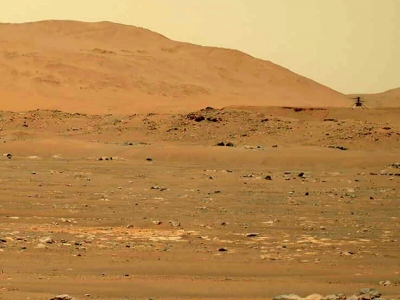
Scientific debate regarding the past of Mars is in full swing following the announcement of a discovery already characterized as a "turning point" for planetary science. NASA's Curiosity rover, which has been exploring Gale Crater since 2012, revealed the most diverse array of organic molecules ever found, paving the way for an understanding of primordial life in our solar system. After a multi-year ascent of Mount Sharp, Curiosity reached clay-bearing layers in the Glen Torridon region, where water once appeared and disappeared periodically. There, at the site named Mary Anning (in honor of the pioneering British paleontologist), the rover performed a landmark experiment.
Using the SAM (Sample Analysis at Mars) instrument located in its interior, Curiosity did not limit itself to simple sample heating. It conducted a rare "wet chemistry" experiment, immersing crushed sandstone in a corrosive solution (TMAH). This allowed for the identification of 21 carbon-containing molecules, seven of which had never been detected before on the Red Planet.
The connection to Earth
The findings include nitrogenous heterocycles, chemical structures that serve as the precursors to RNA and DNA. Simultaneously, benzothiophene was detected, a substance found in meteorites such as Murchison, which fell to Earth in 1969.
"The same material that fell on Mars from meteorites is what fell on Earth, potentially providing the building blocks for life," noted the study's lead, Dr. Amy Williams. For his part, Curiosity project scientist at JPL, Ashwin Vasavada, expressed his awe: "The revelation for me wasn't just that Mars was habitable, but how surprisingly habitable it was."
The future of exploration
Despite the excitement, scientists clarify that the experiment cannot confirm whether the molecules originate from living organisms or geological processes. Dr. Briony Horgan of Purdue University emphasizes that returning samples to Earth remains the "ultimate priority."
However, the future remains uncertain. Although the experiment paves the way for future missions such as the Rosalind Franklin rover (ESA) and Dragonfly (NASA) to Titan, the US Congress recently canceled the ambitious plan to return samples from the Perseverance rover due to cost. Scientists, however, are not backing down. For Vasavada and his team, the return of these samples is the only way to complete a decades-long search. "I want the story to end," he concludes.
www.bankingnews.gr










Σχόλια αναγνωστών